Millilitres, Marks and Memory: A Sceptical UK Guide to CBD Oil Measurement
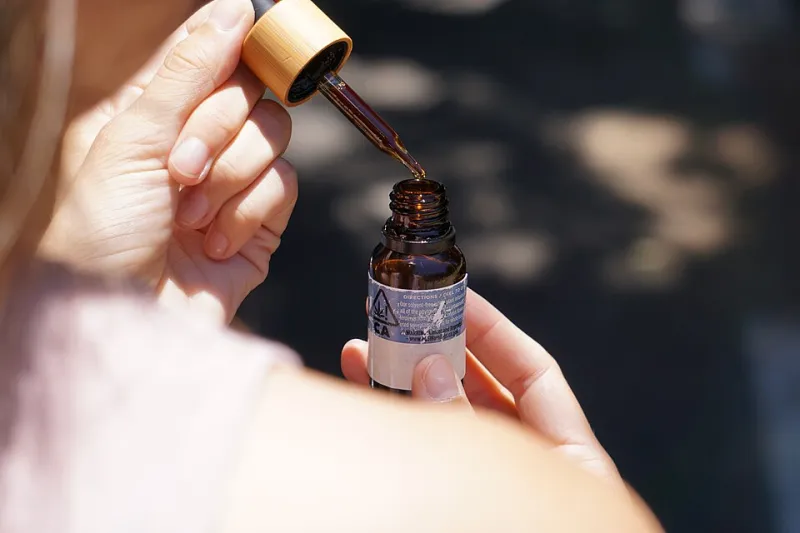
Photo: elsaolofsson, CC BY 2.0, via Wikimedia Commons
Few phrases in everyday CBD guidance are as friendly — or as slippery — as 'one dropper'. It sounds precise enough for a kitchen table, yet it can mean almost anything once the bottle is in hand. For UK shoppers trying to judge whether a product or routine suits them, the more useful question is not whether the language feels reassuring, but whether the measurement can be repeated. This is a guide to bringing ordinary rigour to that task without turning a domestic habit into a clinical protocol.
Why 'One Dropper' Is a Weak Unit
A dropper is a delivery device, not a standard measure. Two bottles may both carry a glass pipette, but the aperture, the liquid's thickness and the angle at which the dropper is held can all affect how much arrives in the mouth. A filled dropper held vertically is not necessarily the same as one squeezed under pressure or emptied in a hurry before the school run. The phrase 'a few drops' is even less stable: it may describe three drops to one person and eight to another.
The practical problem is comparability. If a shopper changes product, format or routine, a vague unit makes it difficult to tell what has actually changed. The same applies when keeping notes for a pharmacist or clinician. A record that says 'one dropper, felt tired' offers little to work with. A record that says '0.5 ml, 20:30, after dinner, slept poorly' at least gives a pattern a chance to emerge.
Reading the Marks on the Glass
Many CBD oil droppers include graduation marks, often at 0.25 ml, 0.5 ml or 1 ml. These marks deserve more attention than the marketing text on the box. They are not a guarantee of pharmaceutical precision, but they are a better starting point than counting droplets in the air. A shopper should check whether the mark is easy to see against the liquid, whether the pipette fills cleanly and whether the bottle's instructions refer to millilitres or drops.
It is also worth noting that a dropper may not hold a full millilitre even when it looks full. Some pipettes are designed to draw a smaller volume. Others may hold more than the marked line if overfilled. The sensible kitchen-table approach is modest: use the printed mark, keep the dropper upright, and avoid treating the bulb squeeze as a measuring instrument. If the markings are absent or illegible, that is useful consumer information in itself.
Millilitres, Drops and the Assumption in Between
A common assumption is that one millilitre equals a fixed number of drops. In practice, drop size varies with the liquid, the dropper tip and the technique used. A thicker oil may form larger droplets; a thinner one may run more freely. Counting drops can therefore create an impression of accuracy that the method does not support. For a domestic routine, millilitres are usually the more honest unit because they are printed on the bottle and can be checked against the dropper.
This does not mean every shopper needs laboratory glassware. A marked pipette and a consistent technique are enough for ordinary comparison. The aim is not to mimic a clinic, but to reduce the number of variables. If a person always uses the same bottle, the same marked line and a similar time of day, they are already in a stronger position than someone relying on memory and mood alone.
Timing Is Part of the Measurement
Measurement is not only about volume. When a product is taken can matter as much as how much is recorded, especially when someone is trying to understand their own routine. A capsule taken with breakfast, an oil taken mid-afternoon and a balm applied in the evening are not interchangeable entries in a diary. Even within oils, taking a measure before food, after food or alongside caffeine may influence how the routine is experienced.
For UK readers, the everyday rhythm of the day is a useful anchor: the kettle, the commute, lunch, the school pick-up, the evening meal. Recording the time in relation to those anchors is often more practical than noting a exact clock time that will vary. Consistency matters more than perfection. A shopper who takes a measured amount at roughly the same point in the day for a fortnight will have something more useful to review than a shopper who improvises and then tries to reconstruct the week from memory.
A Kitchen-Table Record That Stays Useful
A simple notebook or phone note can be enough. The entry need not be elaborate: date, product name, batch number if visible, volume in millilitres, time of day, and a brief note on context. Context might include food, sleep, stress, exercise or any prescribed medicines taken that day. Subjective notes should be plain rather than promotional: 'calmer after dinner' is more useful than 'worked brilliantly'.
It also helps to record what was not done. A missed day, a changed bottle or an unusually early dose can explain a shift that might otherwise be attributed to the product alone. After two to four weeks, the record can be reviewed for patterns rather than dramatic conclusions. The purpose is not to prove a effect, but to make the routine legible enough to discuss sensibly.
When the Audit Should Stop
There are limits to what a kitchen-table audit can settle. Anyone who is pregnant or breastfeeding, taking prescribed medicines, managing a long-term condition or experiencing unexpected symptoms should not rely on internet guidance or a dropper mark as their main source of advice. A pharmacist or clinician can consider interactions, timing and individual circumstances that a notebook cannot.
Nor should a measurement routine become a way of chasing precision for its own sake. CBD products in the UK vary in presentation and labelling, and a domestic dropper is not a dispensing device. If the process starts to feel like a clinical trial conducted beside the toaster, it has probably exceeded its useful purpose. The modest aim is comparability: a clearer sense of what was taken, when, and in what context.
The Modest Aim: Comparability, Not Clinical Precision
In 2026, UK shoppers have more CBD formats and claims to navigate than ever, which makes plain measurement more valuable rather than less. The kitchen table is not a laboratory, and it does not need to be. A marked pipette, a consistent time and a few honest lines in a notebook can replace the vagueness of 'one dropper' with something more reviewable. That is not a treatment plan. It is simply a better basis for an ordinary conversation.